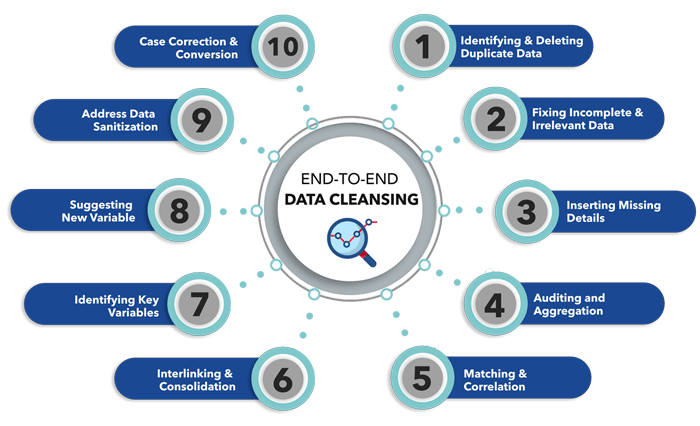
Businesses receive client data from multiple digital channels including mobile apps, search engines, emails, messaging and digital media. All this data, arriving from multiple channels, results in a huge repository of business data. When used wisely, this data can prove to be an asset for an organization, otherwise a burdensome mass.
What is Data Cleansing?
Data cleansing has emerged as a vital technique of data improvement in recent times. It is a data preparation activity where large volumes of data is sanitized using data cleansing tools and methodologies. The data cleansing process generally includes formatting, classification, merging & sorting, correction, insertion, modification, and replacement, of data. The aim and objective of data cleansing is to ensure that data is free from any kind of errors, omissions, duplicate and irrelevant information, inconsistencies, and incompletions. Data cleansing is considered a prerequisite for the process of data analysis.
Benefits Offered By Data Cleansing To Modern Businesses:
- It strengthens customer acquisition efforts. Data cleansing ensures the accuracy of data that results in streamlined marketing efforts, better customer engagement and successful campaigns.
- It facilitates effective decision making. Data cleansing, when performed correctly, improves the quality of data. High-quality data results in effective analysis, which further leads to effective decision making.
- It streamlines business processes. Data cleansing, combined with effective data analysis, helps in identifying the gaps in various business processes and streamlines business processes.
- It boosts staff productivity. By virtue of data cleansing, your sales and marketing team will have quality client data at their disposal. This naturally boosts their efforts and results in high productivity.
- It helps in increasing the revenue. Data cleansing prevents wasteful expenditure on managing duplicate or irrelevant data. It also increases revenue by improving your business’s response rate.
Key Steps in Data Cleansing Process
There are four key steps involved in the data cleansing process. They are:
- Remove unwanted data – In any given data set, unwanted data or information is a group of entries that are either duplicate or irrelevant. Duplicate information, and irrelevant information includes the entries that are out of context in a particular data set.
- Fix structural errors – Structural errors include inconsistent capitalization, typos, mislabeled classes, and other associated mistakes in data. These errors need to be fixed before moving ahead.
- Filter the data of unwanted outliers – It is important to note that not all outliers are unwanted, but some are for sure. Your task is to identify legitimate outliers and get rid of them.
- Deal with missing data – You need to find the missing blocks to complete a picture. Same is the case here. You can’t ignore missing information because this may adversely affect the end result of your analysis. Moreover, most analytics algorithms don’t accept data sets with missing values.
Final Words
Data cleansing is a vital business process and a precondition for effective data analysis. The quality of your business data determines the effectiveness of the results found in data analysis. Proper data cleaning can make or break your project. It is wise to take the services of a reliable data cleansing services provider, especially B2B data cleansing services, to obtain business advantage from the client data available with you. The money you invest in obtaining data cleansing solutions is an investment and not expenditure, as it yields good returns multiple times.
 Business Outsourcing Solutions